Joseph and the Coat of Many Colors

The story of Joseph and the Coat of Many Colors centers around Joseph, the favored son of the patriarch Jacob. Jacob is the grandson of Abraham through Abraham’s son Isaac. The lineage goes like this: Abraham bore Issac who bore Jacob who bore Joseph, one of Jacobs’s thirteen children, twelve of which were sons.
In Genesis we learn that his envious brothers sell Joseph into slavery in Egypt, where he ends up jailed. After correctly interpreting the dreams of Pharaoh, he rises to second-in-command in Egypt; he was vizier, the highest official in ancient Egypt to serve the pharaoh.
Here is his story.
Joseph was born in Padan-aram, a region where his grandfather Abraham lived. He was the eleventh son of Jacob, who was Issac’s son, who in turn was Abraham’s son.
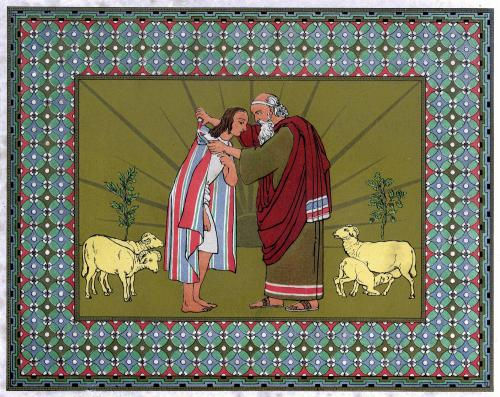
Now, Joseph was Jacob’s favorite son. Jacob gave Joseph the coat of many colors. His brothers, already jealous of Joseph, began to hate Joseph because they perceived that their father loved him more than them.
The situation went from bad to worse. Joseph shared a dream he had with his brothers where he and his brothers were binding sheaves and their sheaves bowed down to Joseph’s sheave. The brothers asked Joseph if he intended to rule them. This dream was followed by a second more ominous dream, where Joseph told his brothers that the sun, moon and elevens stars bowed down to him. The symbolism here is that the sun was Joseph’s father, the moon was Joseph’s mother, and the eleven stars were his brothers, and they all bowed down to Joseph.
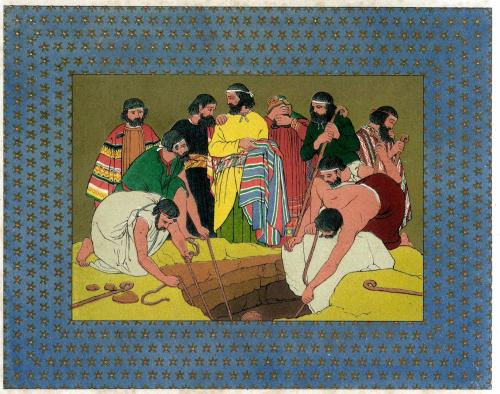
The brothers had had enough, and a plot was underway to kill him. When Joseph approached the brothers, they conspired to throw him into a cistern, which is a pit to hold water. It was there that they an animal would kill him. They would have done so, killed him, if the eldest bother Reuben had not intervened. He persuaded his brothers, saying “Don’t shed any blood.” He told them to throw him into the pit, but don’t kill him.
So, when Joseph approached his brothers, they took off his robe of many colors and tossed him into the cistern, which was empty. When a hoard of Midianite merchants approached, they sold him to them for 20 pieces of silver. The brothers dipped Joseph's coat in goat blood, and showed the bloodied coat to their father Jacob, telling him a lion killed Joseph.
Meanwhile, the merchants brought him to Egypt, and it was there that they sold Joseph to Potiphar, one of Pharaoh’s officials, the captain of the guard. Potiphar put Joseph in charge of his household to care everything he owned. It was then, when he left everything he had in Joseph’s care, that Potiphar’s wife noticed Joseph. Joseph was well-built and handsome; Potiphar’s wife tried to seduce him. When Joseph refused, Potiphar’s wife falsely accused him of attempted rape and Potiphar had Joseph imprisoned.
When the cup bearer and the baker to the king of Egypt offended the king, Pharoah placed them in in the same prison where Joseph was confined. One evening, both men had dreams, and Joseph interpreted them. He told the butler that he would be released and restored to his former position, and he told the baker that he would be executed.
After two years had gone by, Pharaoh had a dream. Standing by the Nile, he saw sleek seven cows come out of the river to graze. Then seven more cows, these ugly, came out of the river and stood by the riverbank. The ugly cows ate the sleek cows. Pharaoh had a second dream, where seven healthy heads of grain, were growing on a single stalk. Then, seven other heads of grain sprouted and there were thin. The thin heads of grain swallowed up the seven healthy heads of grain.
Pharaoh’s wise men could not interpret the dreams, but the butler remembered Joseph and told Pharaoh about his ability to interpret dreams. Pharaoh sent for Joseph, and he was quickly brought from the dungeon. When Joseph was summoned before Pharaoh, he interpreted the dream. Joseph said the dreams were one and the same. G-d has revealed to Pharaoh what he is about to do. Joseph said that the dream was really a warning. “Seven years of great abundance are coming throughout the land of Egypt, but seven years of famine will follow them.” Joseph went on to say “The reason the dream was given to Pharaoh in two forms is that the matter has been firmly decided by God, and God will do it soon.”
Joseph advised the Pharaoh to store surplus grain during the seven years of abundance. Pharaoh followed Joseph’s advice, and during the seven good years large quantities of grain were stored so there would be food available when the famine came. As a result, Egypt was able to survive the seven years of famine without being devastated.
Pharaoh was impressed with Joseph. He made Joseph his chief advisor. In the seven plenteous years, Joseph oversaw the preparation of stored grain. So, when the seven years of famine appeared, there was now enough food for the people. Joseph had saved the people of Egypt during the long famine.
Meanwhile back in Canaan, the people were also experiencing a famine. Jacob learned that there was grain in Egypt; he told his sons to go to forth into Egypt and buy some grain to bring it home. Ten of Jacob’s brothers ventured off to Egypt.
When they arrived, they met with the governor of the land to buy the grain. The governor was Joseph, and while the brothers did not recognize their brother Jacob, Jacob, most assuredly, recognized them.
At that moment, Joseph decided to test their brothers to ascertain if they regretted having sold him into slavery. In a test of loyalty, Joseph accused them of being spies. The brothers replied that they were twelve brothers, and our father and one of the brothers live in Canaan.
Joseph replied that they would be forced to stay in Egypt “unless your youngest brother comes here.” He then told his brothers to send one of them to fetch their brother while he placed the other brothers in jail.
Joseph’s brothers brought their youngest brother, Benjamin, back to Egypt. It was then that Judah, who earlier Judah suggested selling Jospeh instead to traders headed for Egypt, now offered himself in Benjamin’s place, showing the brothers had changed since selling Joseph into slavery. When Joseph saw that his brothers were loyal toward Benjamin, he finally revealed his identity to them. Joseph forgave his brothers and invited his entire family to come and live in Egypt, where they could be provided for during the famine.
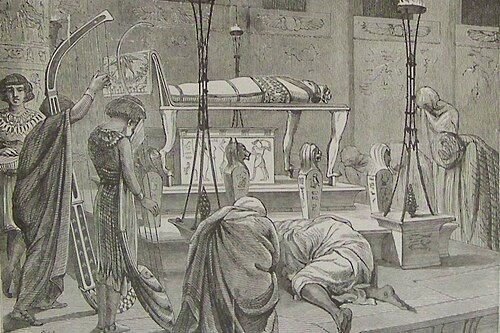
Joseph lived to the age of 110. Before he died, he made the children of Israel swear that when they left the land of Egypt they would take his bones with them. The children of Israel remembered their oath, and when they left Egypt during the Exodus, Moses took Joseph’s bones with him. The bones were later buried at Shechem, traditionally identified as the site of Joseph's Tomb.
Today, Joseph’s Tomb is located in the West Bank, on the outskirts of Nablus, the modern city associated with biblical Shechem.
Last word:
The Israelites lived in Egypt for over 400 years. For much of this time, they were enslaved by a Pharaoh who never know Joseph. Then Moses led the Israelites out of Egypt to return to the Promised Land. After the Exodus, the Israelites traveled toward the Promised Land. When they reached its border, they refused to enter because they feared the inhabitants. As punishment, God condemned that generation to wander in the wilderness for 40 years before entering the land.
Joseph’s story is a story of perseverance, forgiveness and faith. Despite betrayal, slavery, and imprisonment, he remained faithful to G-d and ultimately rose to become a great leader in Egypt.

Comments